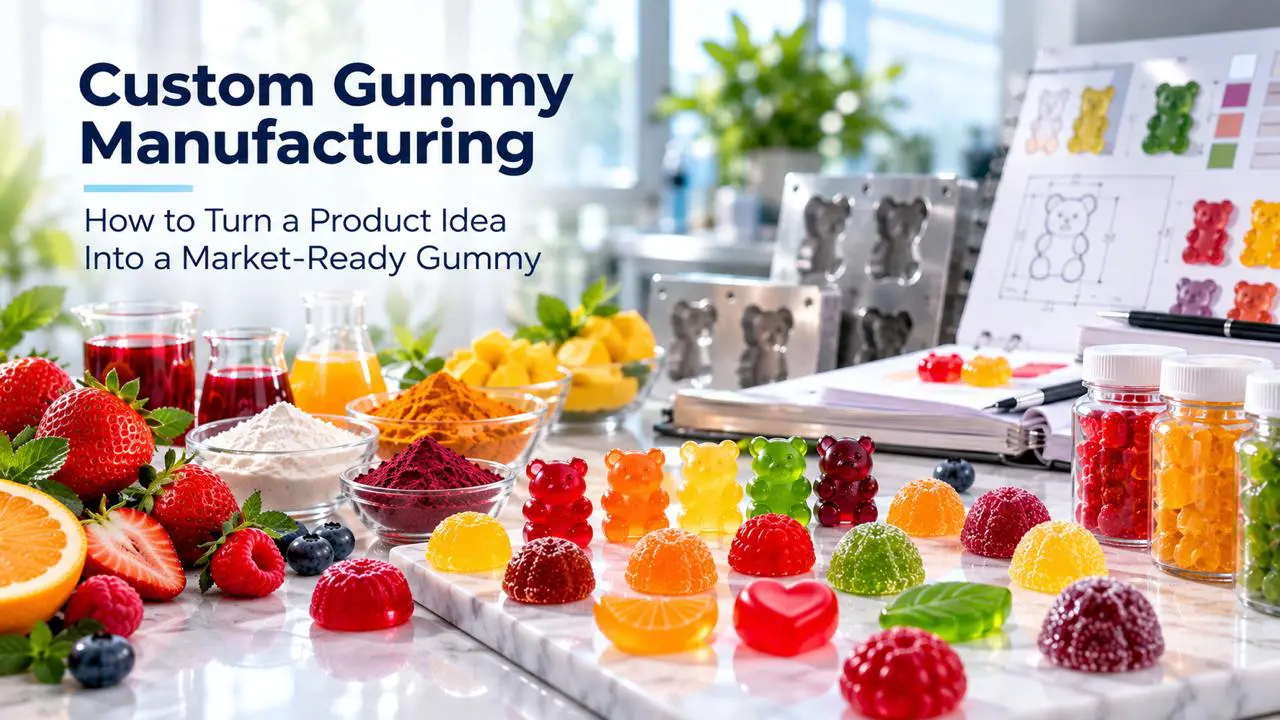
Gummies have evolved far beyond a simple candy format. For brands, they can provide a flexible platform for vitamins, minerals, botanical ingredients and other functional concepts. But turning an idea into a commercially manufactured gummy requires much more than selecting a flavor and a shape.
A successful gummy program needs to connect formulation, ingredient compatibility, taste, texture, dosage, manufacturing, packaging and regulatory considerations. That is why choosing a custom gummy manufacturer with product-development capabilities can be important from the earliest stage of a project.
This guide explains the major decisions brands should understand when moving from a gummy concept to commercial production in the United States.
1. Start With the Purpose of the Gummy
Before discussing flavors, colors or packaging, define what the product is supposed to accomplish. Is it primarily a conventional confectionery product, or is the concept built around vitamins, minerals or other dietary ingredients? The answer can affect formulation, labeling and the regulatory framework that applies to the finished product.
A useful product brief should identify the intended consumer, desired ingredients, target amount per serving, preferred flavor direction, dietary preferences, package format and expected sales channel.
The clearer the concept is at the beginning, the easier it becomes for an R&D team to determine whether the desired product is technically practical.
2. Choose Between Private Label and Custom Formulation
One of the first manufacturing decisions is whether to use an existing formulation or develop something specifically for the brand.
Private Label Gummies
A private label program may use an established manufacturing platform that can be adapted to a brand’s requirements. This can simplify development when speed and a more standardized product are priorities.
Custom Gummy Formulation
Custom development is appropriate when the formula itself is part of the product’s differentiation. A manufacturer with gummy formulation and manufacturing capabilities can evaluate the active ingredients, base system, flavor, sweetness, texture, color and production requirements together.
White Lab USA can work from a client’s existing formula or develop a project around a new product concept.
3. Decide Between Pectin and Gelatin
The gummy base affects texture, consumer positioning and formulation behavior. Gelatin is associated with a traditional elastic chew, while pectin provides a plant-derived alternative that is frequently used for vegan-style gummy concepts.
The decision should not be made from marketing preference alone. The active ingredients, desired texture, manufacturing process, storage conditions and finished-product objectives should all be considered during development.
4. Determine Whether the Desired Dose Fits the Format
One of the most interesting opportunities is using the ice pop as a delivery format rather than viewing it only as a dessert.
A frozen format can potentially be developed around concepts such as hydration, electrolytes, vitamins, energy or other functional ingredients.
For example, a brand could explore a product positioned around: Hydration + Electrolytes or Fruit Flavor + Vitamins or another differentiated formulation designed around a particular consumer use case. However, adding functional ingredients makes formulation more complex. Taste, solubility, stability, ingredient interactions and regulatory considerations all become important. Brands should therefore work with a manufacturer capable of evaluating both the product concept and the practical requirements of commercial production.
5. Flavor Development Is Part of the Formulation
Flavor is not simply added at the end. Functional ingredients can significantly change the taste profile of a gummy, and a flavor that works with one formula may perform poorly with another.
During R&D, the team may need to balance sweetness, acidity, flavor intensity and masking systems to create a finished product consumers will actually want to take repeatedly.
The goal is not only to make the active ingredients fit. The goal is to create a repeatable consumer experience.
6. Consider Shape, Size, Color and Finish
The physical gummy is part of the brand identity. Shape, size, color and finish can help distinguish a product on the shelf and influence how consumers perceive it.
Brands may explore different shapes, colors, sugar-coated or alternative finishes and packaging presentations, depending on the formulation and manufacturing requirements.
These choices should be made early enough to ensure that the product design remains compatible with commercial manufacturing.
7. Understand the Difference Between a Great Sample and a Scalable Product
A development sample is only the beginning. Commercial production introduces larger batch sizes, processing temperatures, mixing procedures, depositing equipment, curing conditions and packaging operations.
A formula therefore needs to be developed with scale in mind. A product that looks excellent in a small sample but cannot be reproduced consistently at commercial volume is not ready for market.
Working with a partner that connects R&D, manufacturing and packaging services can reduce the disconnect between prototype development and production.
8. Packaging Should Be Planned Before Production
Bottle size, pouch format, count per package, label dimensions and secondary packaging can affect the manufacturing program. Packaging also needs to protect the product throughout storage and distribution.
An integrated co-packing and packaging program can help coordinate the transition from manufactured gummies to finished retail-ready goods.
Packaging decisions should therefore be discussed alongside formulation and production—not after the gummies have already been made.
9. Claims and Labeling Need to Match the Product
The regulatory treatment of claims depends on the type of product and the claim being made. The FDA explains the principal categories of claims used for conventional foods and dietary supplements, including health claims, nutrient content claims and structure/function claims.
For dietary supplements, structure/function claims have specific requirements. FDA states that manufacturers must have substantiation that such claims are truthful and not misleading, and certain claims require notification to FDA and the statutory disclaimer. Disease-treatment claims can cause a product to be regulated differently.
Brands developing supplement gummies should review the FDA’s current Questions and Answers on Dietary Supplements and obtain appropriate regulatory review for the specific formula and claims before launch.
10. Build the Product for Repeat Commercial Production
A commercially successful gummy needs to be more than creative. It needs to be reproducible.
Manufacturing specifications, ingredient controls, processing steps, packaging requirements and quality procedures should support consistent production from batch to batch.
Brands should ask how the manufacturer manages the transition from development to production and how future volume increases will be handled if the product gains distribution.
10. Build the Product for Repeat Commercial Production
A commercially successful gummy needs to be more than creative. It needs to be reproducible.
Manufacturing specifications, ingredient controls, processing steps, packaging requirements and quality procedures should support consistent production from batch to batch.
Brands should ask how the manufacturer manages the transition from development to production and how future volume increases will be handled if the product gains distribution.
From Concept to Commercial Gummy Production
A typical custom gummy project can be viewed as a sequence:
Step 1 — Product Brief
Define the consumer, product purpose, ingredients, target serving, flavor direction and packaging objectives.
Step 2 — Technical Review
Evaluate whether the desired formula and ingredient load are appropriate for the gummy format.
Step 3 — Formulation & R&D
Develop or adapt the base, active ingredients, flavor, sweetness, acidity, texture and appearance.
Step 4 — Sampling & Refinement
Review the prototype and adjust the product until the core specifications are established.
Step 5 — Packaging Coordination
Finalize the package format, artwork requirements, count and finished-product configuration.
Step 6 — Commercial Manufacturing
Transfer the approved specifications into repeatable production.
Step 7 — Scale
Plan future production as distribution and demand increase.
Custom & Private Label Gummy Manufacturing With White Lab USA
White Lab USA provides custom and private label gummy manufacturing for brands seeking a manufacturing partner that can support the product from concept through commercial production.
Our approach can include custom formulation, R&D, manufacturing from client-provided formulas, flavor and product development, packaging coordination and finished-product preparation. Each program is evaluated according to its own formulation, production and packaging requirements.
White Lab USA has been manufacturing in the United States since 2010. The objective is to give both emerging and established brands access to a manufacturing relationship that can support product development as well as continued commercial production.
If you are developing a gummy product or looking for a new manufacturing partner, contact White Lab USA to discuss your concept, formula and production requirements.
Frequently Asked Questions About Custom Gummy Manufacturing
Can I bring my own gummy formula to a manufacturer?
Yes, depending on the formula and manufacturer. The formula should be reviewed for ingredient compatibility, processing requirements, dosage, flavor, texture and commercial-scale feasibility.
Can a manufacturer develop a custom gummy from an idea?
A manufacturer with in-house R&D can develop a project from a product brief, including the gummy base, active ingredients, flavor profile, texture, color and other specifications.
What is the difference between pectin and gelatin gummies?
Gelatin generally produces a traditional elastic chew, while pectin is plant-derived and is commonly selected for vegan-style gummy concepts. The best choice depends on the formula and desired finished product.
Can functional ingredients be added to gummies?
Many vitamins, minerals, botanicals and other ingredients may be suitable for gummy applications, but compatibility, dosage, taste, processing and applicable regulatory requirements need to be evaluated for the specific formula.
Does White Lab USA manufacture custom gummies?
Yes. White Lab USA provides custom and private label gummy manufacturing, including R&D, formulation support, production and packaging coordination.