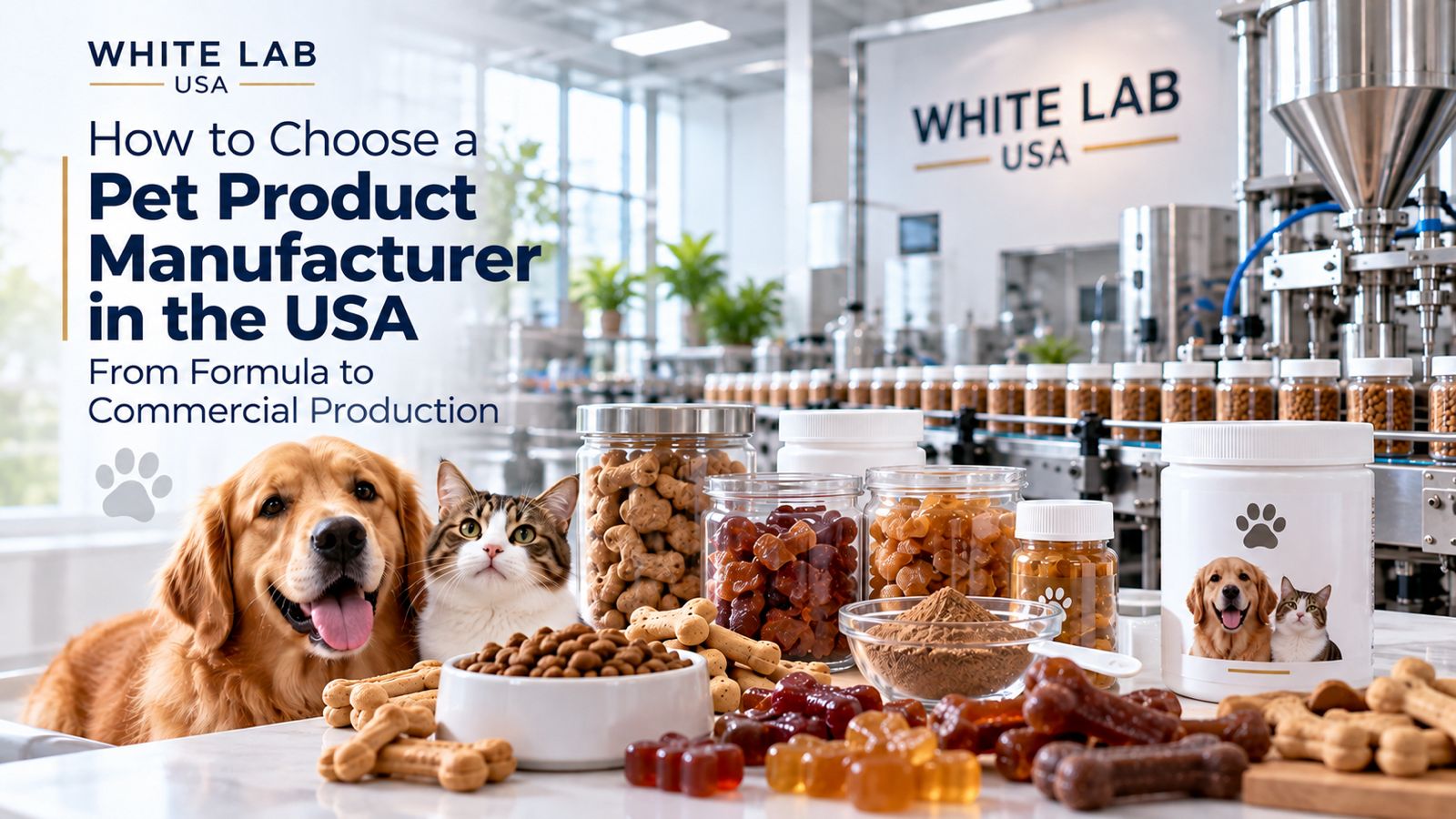
The pet market creates opportunities for brands to develop products far beyond conventional pet food. Treats, specialty formulations, tincture-style liquids, grooming products and other pet-care concepts can all require different development, manufacturing, packaging and regulatory strategies.
For a company searching for a pet product manufacturer in the USA, the challenge is not simply finding someone who can produce an item. The manufacturer should understand how the product, ingredients, intended use, packaging, claims and commercial production requirements fit together.
This guide explains the key questions brands should consider when moving a pet product from concept to repeat commercial production in the United States.
1. Start by Defining Exactly What You Are Manufacturing
The term “pet product” covers very different categories. A dog treat is not developed or regulated in the same way as a pet shampoo, grooming product or another non-food item.
Before requesting a quotation, define the intended animal, product format, ingredients, serving or use instructions, packaging, desired claims and sales channels.
This first step helps determine which manufacturing process, quality controls and regulatory framework may apply to the project.
2. Decide Whether You Need Private Label or Custom Development
A brand may begin with an existing product platform or develop something more specific.
Private Label Pet Products
A private label program can be useful when a brand wants a more streamlined path using an established product or manufacturing platform that can be configured around its branding and packaging requirements.
Custom Pet Product Development
Custom development is appropriate when the formulation, format or product experience is central to the brand. A manufacturer with in-house R&D and product development capabilities can evaluate ingredients, flavor or sensory characteristics, format, processing, packaging and commercial feasibility together.
White Lab USA can work from client-provided specifications or collaborate on the development and refinement of a new product concept.
3. Ingredient Selection Must Be Appropriate for the Intended Animal and Use
An ingredient that is familiar in a human product should not automatically be assumed to be appropriate for an animal product.
FDA explains that substances added to animal food must have an appropriate regulatory status for their intended use. Depending on the substance and use, an ingredient may need to be an approved food additive, generally recognized as safe (GRAS) for that intended use, or otherwise legally permitted. Brands can review the FDA’s Animal Food Ingredients resources when developing animal-food concepts.
The intended species, amount, frequency of use and finished-product positioning should therefore be considered during formulation rather than after the formula has already been completed.
4. Understand the Regulatory Difference Between Animal Food and “Pet Supplements”
This is an important distinction for U.S. brands. FDA states that the Dietary Supplement Health and Education Act (DSHEA), which created the federal dietary-supplement framework for humans, does not apply to animal food. FDA therefore does not recognize a separate federal “dietary supplement” regulatory classification for products intended for animals. FDA’s Animal Foods & Feeds overview explains that products sometimes marketed commercially as animal supplements may instead be regulated as animal food or as new animal drugs depending on their composition, intended use and claims.
For that reason, a brand should not simply copy the regulatory strategy used for a human dietary supplement and apply it to a pet product.
5. Claims Can Change How a Pet Product Is Regulated
Marketing language needs to be considered during product development, not only after manufacturing.
FDA explains that expressed or implied claims indicating that an animal product is intended to cure, treat, prevent or mitigate disease—or affect the structure or function of the animal’s body in a manner beyond food purposes—can indicate an intended use as a new animal drug. Review the FDA’s Animal Food Labeling and Pet Food Claims guidance before finalizing product positioning.
This means formulation, labeling, website copy, brochures, testimonials and other promotional materials should be reviewed as part of the same compliance strategy.
6. Pet Treat Manufacturing Requires Food-Safety Planning
When the product is animal food, commercial manufacturing can trigger food-facility and preventive-control requirements depending on the facility and activity.
FDA’s How Do I Start an Animal Food Business? resource explains that commercial animal-food businesses may need food-facility registration and must comply with applicable food-safety, ingredient, labeling, recordkeeping and state requirements.
Facilities subject to the Preventive Controls for Animal Food rule operate under 21 CFR Part 507, which includes current good manufacturing practice requirements and, when applicable, hazard analysis and risk-based preventive controls.
The specific requirements depend on the facility, product and applicable exemptions or modified requirements, so each manufacturing program should be evaluated individually.
7. Packaging Is Part of the Manufacturing Program
Pet-product packaging needs to perform operationally as well as visually. Pouches, jars, bottles, droppers, pumps and other formats can create different filling, sealing, labeling and shipping requirements.
Working with a manufacturer that can coordinate co-packing and packaging can reduce the number of separate vendors involved in moving a product from manufacturing to finished goods.
Packaging should therefore be selected early enough to evaluate compatibility with the product and intended production process.
8. Ask How Quality, Traceability and Production Records Are Managed
A commercial manufacturing relationship should include clear product specifications, ingredient controls, production records, lot identification and quality procedures appropriate to the product category.
Brands should ask how incoming materials are documented, how production lots are identified, what quality checks are performed and how finished-product specifications are confirmed.
Traceability becomes particularly important when a brand expands distribution and production volume.
9. Plan the Product for Scale, Not Only for the First Order
A small initial launch and an established national program can have very different production requirements.
Before selecting a manufacturer, discuss how additional flavors, formulas, package sizes, SKUs and higher production volumes could be incorporated later.
White Lab USA’s broader private label manufacturing capabilities allow product development, manufacturing, filling and packaging to be coordinated within a wider manufacturing relationship as a brand’s requirements evolve.
10. Choose a Partner That Understands Both the Product and the Brand
The best manufacturing relationship is not simply a transaction for a finished unit. A brand may need formulation work, samples, packaging changes, new SKUs, production adjustments and scale-up over time.
A manufacturer that understands the commercial objective behind the product can help coordinate these stages more efficiently than a supplier focused only on one production run.
This is especially valuable when the brand intends to build a broader pet-care collection rather than launch a single isolated SKU.
From Pet Product Concept to Commercial Manufacturing
A typical custom beverage project can be viewed as a sequence:
Step 1 — Define the Product
Identify the animal, product category, format, intended use, ingredients, packaging and commercial positioning.
Step 2 — Regulatory & Ingredient Review
Determine the applicable product category and evaluate ingredient status, intended use and proposed claims.
Step 3 — Formulation or Product Selection
Use an existing specification, select an appropriate private label platform or begin custom R&D.
Step 4 — Sampling & Refinement
Evaluate flavor or sensory characteristics, format, appearance, application and other product-specific requirements.
Step 5 — Packaging & Label Development
Coordinate the container, label, directions, required information and finished-product configuration.
Step 6 — Commercial Manufacturing
Transfer approved specifications into controlled and repeatable production.
Step 7 — Scale & Line Extension
Expand production, formats or SKUs as distribution and demand develop.
Private Label & Custom Pet Product Manufacturing With White Lab USA
White Lab USA provides private label and custom pet product manufacturing for brands developing pet treats, tincture-style products and other specialized pet-product concepts.
Depending on the project, our team can support product development, custom formulation, manufacturing from client-provided specifications, filling, packaging coordination and finished-product preparation.
White Lab’s manufacturing experience began in 2010, and our approach is designed to support both emerging brands and established commercial programs with flexible development and production capabilities.
If you are developing a pet product or evaluating a new manufacturing partner, contact White Lab USA to discuss your concept, formula, packaging and production requirements.
Frequently Asked Questions About Pet Product Manufacturing
What should I look for in a pet product manufacturer in the USA?
Evaluate the manufacturer’s experience with your specific product category, formulation capabilities, ingredient review, quality systems, packaging capabilities, regulatory awareness, documentation and ability to scale.
Can a manufacturer develop a custom pet treat formula?
A manufacturer with appropriate R&D and animal-food manufacturing capabilities may be able to develop or adapt a formula, subject to ingredient suitability, regulatory status, processing requirements and the intended product claims.
Are pet supplements regulated like human dietary supplements?
No. FDA states that DSHEA does not apply to animal food and does not recognize a separate federal dietary-supplement classification for animal products. Depending on composition, intended use and claims, a product may be regulated as animal food or as a new animal drug.
Do pet-food manufacturers need FDA registration?
Commercial facilities that manufacture, process, pack or hold animal food generally must register with FDA unless an exemption applies. Additional preventive-control and recordkeeping requirements may also apply depending on the facility and activity.
Does White Lab USA manufacture private label pet products?
Yes. White Lab USA provides private label and custom pet-product manufacturing capabilities, including pet treats, tincture-style products and specialized formulations, depending on project requirements.
Editorial note: Regulatory information is general and sourced to FDA resources current as of September 30, 2026. Product-specific requirements depend on the formula, claims, process, packaging, facility and distribution model.