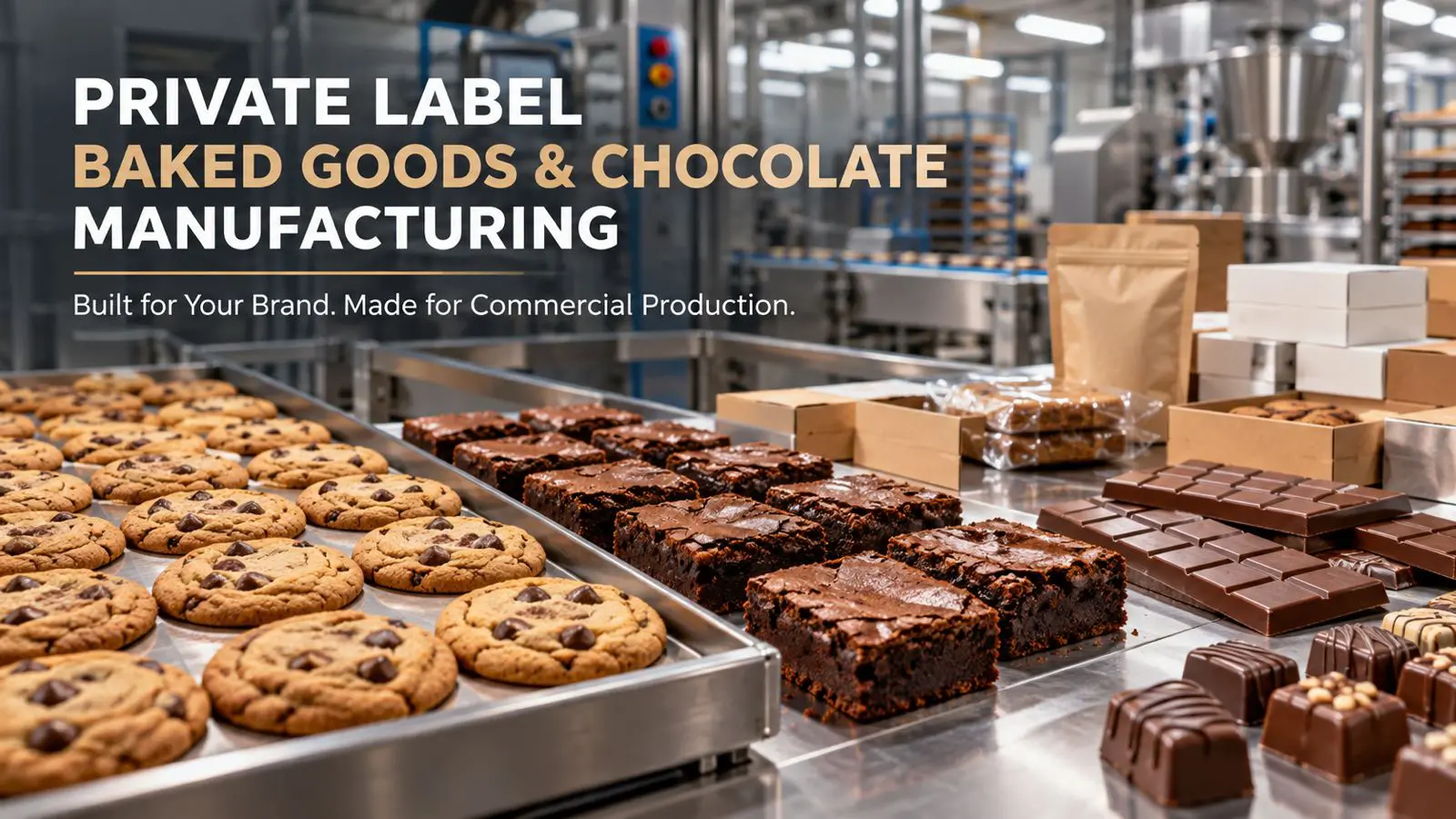
Bringing a cookie, brownie, chocolate bar or other baked product to market involves much more than finding a facility capable of producing it.
For brands planning commercial production, the right manufacturing partner must be able to combine product development, repeatable production, quality control, packaging flexibility and regulatory awareness within a manufacturing process designed for scale.
At White Lab, we work with brands looking to develop and manufacture customized food products in the United States, from early product development through commercial production.
Whether the objective is launching a new product, expanding an existing line or moving production to a manufacturing partner, understanding what happens behind the scenes can help brands make better decisions before entering production.
1. From a Product Idea to Commercial Manufacturing
A successful commercial product starts long before the first large production run.
The development process may involve evaluating the desired product format, texture, flavor profile, ingredients, serving size, packaging requirements and intended positioning.
For baked goods and chocolate products, relatively small formulation or process changes can affect the finished product. Temperature, ingredient ratios, mixing procedures, baking conditions, cooling time, chocolate handling and packaging can all influence consistency and stability.
This is why moving from a concept or kitchen-scale recipe to commercial manufacturing requires more than simply multiplying the ingredients. A manufacturing process must be developed so that the product can be produced consistently and repeatedly at commercial scale.
2. Cookie Manufacturing for Private Label Brands
Cookies offer brands significant flexibility in product development. Different projects may require changes in size, texture, flavor, inclusions, coatings, fillings or packaging configuration.
A commercial cookie manufacturing program may include formula development and optimization, ingredient sourcing, dough preparation, portion control, baking, cooling, quality checks, packaging and preparation for commercial distribution.
The objective is not simply to manufacture one successful batch. The manufacturing process should be capable of reproducing the desired product characteristics from one production run to the next.
For growing brands, this repeatability becomes increasingly important as order volumes increase and products reach more customers.
3. Brownie and Baked Goods Manufacturing
Brownies and other baked products present their own manufacturing considerations. Texture, moisture, density, portion size and packaging can significantly affect the finished product and its commercial positioning.
Depending on the project, brands may also need to evaluate individual packaging, multipacks, retail boxes or other configurations.
Commercial manufacturing therefore requires coordination between the formula, production process and final packaging format rather than treating each element independently.
At White Lab, product development can be approached with the final commercial objective in mind from the beginning.
4. Private Label Chocolate Manufacturing
Chocolate provides another opportunity for brands to create distinctive products. Projects can include different formats, flavors, inclusions, fillings, textures, bar sizes and packaging concepts.
But chocolate manufacturing also requires careful process control. Temperature management, ingredient handling, molding, cooling and packaging conditions can all influence the appearance and consistency of the finished product.
For brands developing chocolate products, choosing a manufacturer with both product-development capabilities and commercial-production experience can help create a smoother transition from concept to finished goods.
5. Food Safety and Allergen Management Matter
Food manufacturing in the United States involves important regulatory and food-safety responsibilities.
Commercial food facilities may be subject to FDA requirements including Current Good Manufacturing Practices and, where applicable, hazard analysis and risk-based preventive controls under 21 CFR Part 117.
For products such as cookies, brownies and chocolate, allergen management is particularly important because formulations commonly involve ingredients such as milk, eggs, wheat, soy, peanuts, tree nuts or sesame.
A professional manufacturing program should therefore consider ingredient controls, sanitation, allergen cross-contact prevention, production procedures and accurate labeling as part of the overall manufacturing process.
6. Packaging Is Part of the Product
Packaging should not be treated as an afterthought.
The appropriate packaging configuration depends on the product, distribution model, branding strategy and intended customer experience.
A brand may require individually wrapped products, multipacks, pouches, boxes, trays or another customized configuration.
The manufacturing partner should therefore evaluate packaging requirements early in the development process so that the product and packaging can be designed to work together efficiently.
7. Manufacturing for Emerging and Established Brands
Different brands require different manufacturing strategies.
An emerging brand may need support turning an initial concept into a commercially viable product. An established company may already have a formula, packaging and defined specifications and simply require a reliable manufacturing partner capable of executing the project consistently.
Others may want to expand an existing portfolio by adding cookies, brownies, chocolate products or complementary product formats.
The manufacturing relationship should therefore be flexible enough to accommodate different stages of brand development rather than forcing every project into the same structure.
8. Why Manufacturing Flexibility Matters
Consumer brands rarely remain static. Successful products can lead to additional flavors, sizes, packaging formats and entirely new product categories.
Working with a manufacturing partner capable of supporting multiple product formats can make future portfolio expansion easier.
Instead of rebuilding the manufacturing infrastructure for every new concept, brands can develop a longer-term relationship with a partner that understands their products, standards and commercial objectives.
9. Choosing a Baked Goods and Chocolate Manufacturer in the USA
Before selecting a manufacturing partner, brands should evaluate more than unit pricing.
Important considerations include manufacturing experience, product-development capabilities, quality systems, regulatory awareness, ingredient sourcing, packaging capabilities, communication, production flexibility and the ability to support future growth.
The objective should be to find a manufacturer capable of supporting not only the first production run, but the broader development of the brand.
10. Build Your Next Product With White Lab
White Lab provides manufacturing and product-development solutions for brands seeking to bring customized products to the U.S. market.
From cookies and brownies to chocolate and other custom food products, our team can work with brands at different stages of development, from initial concept and formulation through packaging and commercial manufacturing.
Whether you are preparing your first production run, expanding an established product line or searching for a new U.S. manufacturing partner, White Lab can evaluate your project and help determine the appropriate path toward commercial production.
Contact White Lab to discuss your next cookie, brownie, chocolate or custom food manufacturing project.