A U.S. Supplement Market Worth Nearly $69 Billion
The U.S. dietary supplement industry continues to expand, and gummies have become one of its most important delivery formats. What began largely as a vitamin format for children has evolved into a broad platform for adult wellness, specialized formulations and brand innovation.
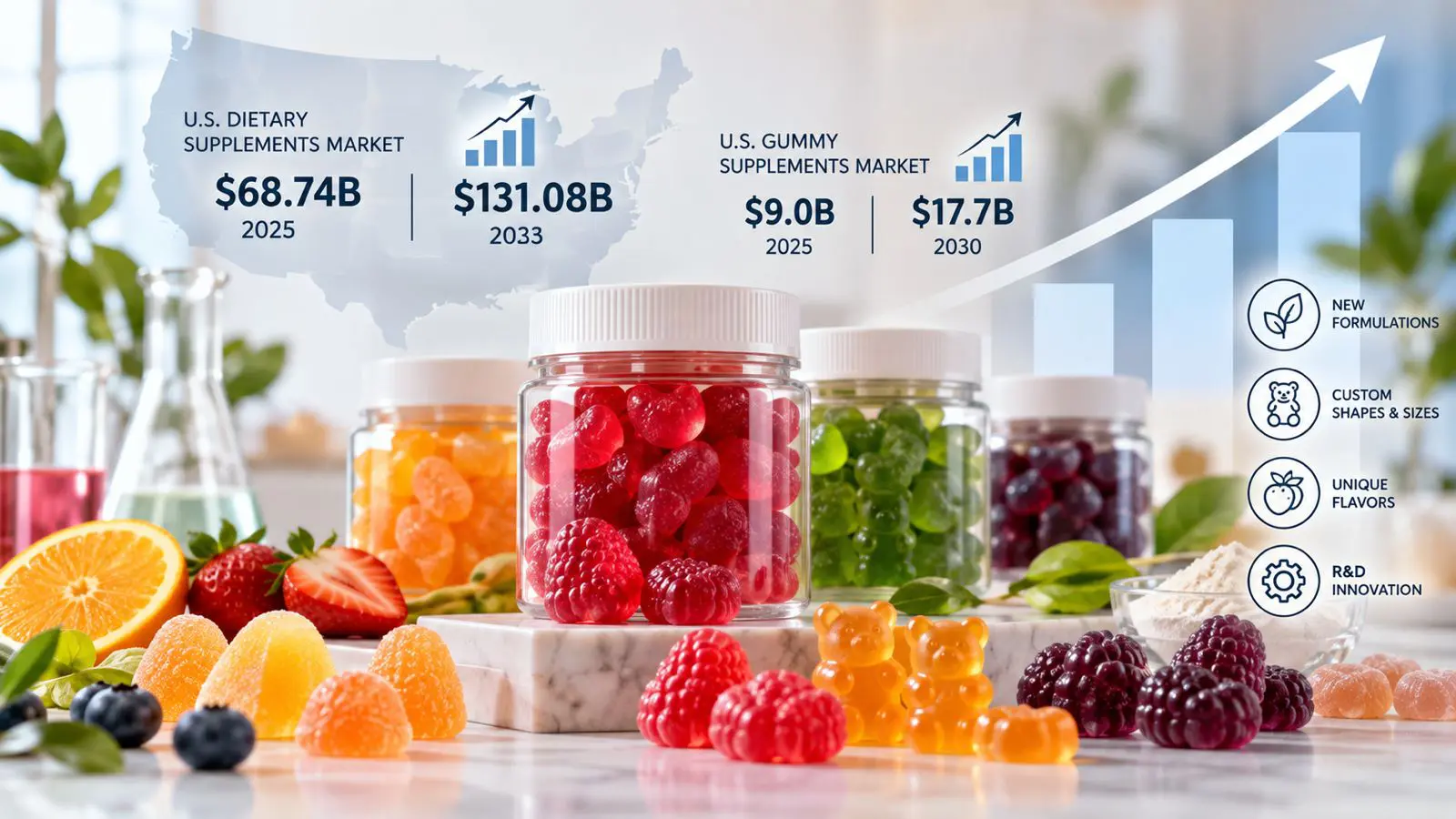
According to Grand View Research, the U.S. dietary supplements market generated approximately $68.74 billion in revenue in 2025 and is projected to reach about $131.08 billion by 2033. Within that larger market, gummies are showing particularly strong momentum.
MarketsandMarkets valued the U.S. gummy supplements market at approximately $9.02 billion in 2025 and projects it to reach about $17.70 billion by 2030, representing a compound annual growth rate of 14.4%.
For brands, these numbers point to something larger than a temporary product trend: the gummy has become a flexible product-development platform that can combine consumer-friendly delivery, flavor, branding and increasingly specialized formulation concepts.
The broader supplement category provides the foundation for gummy growth. Grand View Research reports U.S. dietary supplement revenue of $68.74 billion in 2025, with projected revenue of $131.08 billion by 2033 and an expected CAGR of 8.3% from 2026 through 2033.
Vitamins were the largest ingredient segment in 2025, while proteins and amino acids were identified as the fastest-growing ingredient segment in the firm’s current outlook.
This expanding market creates room for brands to compete not only through ingredients, but also through delivery format, consumer experience, positioning and product design.
The U.S. Gummy Supplement Market Could Nearly Double by 2030
The growth rate of gummy supplements is especially notable. MarketsandMarkets estimates the U.S. market at $9.015 billion in 2025 and forecasts $17.698 billion by 2030.
That represents a projected CAGR of 14.4%, with the research firm pointing to demand for convenient, taste-friendly delivery formats, product innovation, preventive-wellness interest and expanding e-commerce as important market drivers.
For manufacturers and brands, this means gummies are no longer a narrow subcategory of vitamins. They are becoming a mainstream delivery system for a much wider range of supplement concepts.
Younger Consumers Are Helping Drive the Format
Consumer preference helps explain why the format continues to attract product development.
Data from Nutrition Business Journal cited by Glanbia Nutritionals shows that among U.S. consumers who frequently take supplements, 38% of Gen Z and 30% of Millennials identified gummies as their favorite format.
The same source reports that taste was the most important characteristic for gummy users at 52%, ahead of affordability at 37% and high-quality ingredients at 25%.
For brands, that is an important reminder: a successful supplement gummy is not simply an active-ingredient delivery vehicle. Taste and the overall product experience are central to consumer acceptance.
Gummies Have Moved Beyond the Basic Multivitamin
Vitamins remain an important part of the category, but gummy innovation increasingly extends into more targeted product concepts.
Depending on the formulation, regulatory framework and commercial objective, brands may explore concepts built around vitamins, minerals, botanicals, amino acids and other dietary ingredients, as well as positioning for areas such as general wellness, energy, focus, relaxation, sleep, beauty or other permissible supplement concepts.
The opportunity is not to place every possible ingredient into a gummy. It is to develop a product in which the active system, serving size, flavor, texture and consumer positioning work together.
R&D Is Becoming a Competitive Advantage
As gummy concepts become more specialized, research and development becomes increasingly important.
A formula may need to balance active ingredients with taste, sweetness, acidity, texture, color, stability and serving size. Ingredients that work well in capsules, powders or beverages do not automatically create the same experience in a gummy.
R&D gives a brand the ability to develop the product as a complete system rather than selecting a generic base and adding ingredients at the end.
At White Lab USA, the development process can begin with a concept, an existing formula or a target product profile. Depending on the project, R&D can be used to develop or refine the formula and evaluate the path toward commercial manufacturing.
The Gummy Itself Can Be Customized
Innovation is not limited to the active ingredients.
A gummy program can also be differentiated through flavor direction, color, texture, size, shape, serving configuration and packaging. Depending on the project, brands may also explore different base systems and formulation approaches.
This gives companies an opportunity to build a recognizable product experience rather than competing only on the Supplement Facts panel.
For White Lab USA, the objective is to evaluate each project individually and develop the most appropriate product format around the brand’s commercial goals and requested specifications.
Taste Can Be as Important as the Ingredient Story
The Nutrition Business Journal data cited by Glanbia is particularly useful for product developers because 52% of gummy users identified taste as the most important characteristic they seek.
This helps explain why gummy R&D cannot focus exclusively on dosage.
Botanicals, minerals, vitamins and other dietary ingredients can introduce bitterness, acidity, aftertaste or other sensory challenges. Flavor development and texture therefore become part of the functional design of the product.
A strong formula needs to make sense both on paper and when the consumer actually eats the gummy.
Serving Size and Active Load Shape the Product
Not every formulation fits naturally into the same gummy size or serving configuration.
The amount and characteristics of the requested ingredients can influence the number of gummies per serving, individual gummy size, texture, flavor system and other formulation decisions.
This is one reason custom product development is important. Instead of forcing a concept into a predetermined format, the formulation and delivery format can be evaluated together.
The result is a more realistic development path from the desired ingredient profile to a commercially manufacturable product.
Product Positioning and Claims Need to Be Considered Early
A supplement concept is also defined by the claims and marketing language surrounding it.
FDA distinguishes among health claims, nutrient content claims and structure/function claims. For dietary supplements, structure/function claims can describe the role of a nutrient or dietary ingredient intended to affect the normal structure or function of the body, but the company making the claim must have substantiation that it is truthful and not misleading.
FDA also requires notification no later than 30 days after first marketing a dietary supplement with a qualifying structure/function claim, and the required disclaimer must accompany the claim.
For brands, claims should therefore be considered alongside formulation and labeling rather than added only after product development is complete.
From Market Opportunity to a Differentiated Gummy
A growing market creates opportunity, but it also creates competition.
Simply launching another standard gummy may not be enough to build a distinctive brand. Product strategy can begin by identifying the target consumer, intended benefit or positioning, ingredient direction, flavor experience, serving format and packaging concept.
From there, formulation and R&D can translate the commercial idea into a product-development program.
This is where the flexibility of the gummy format becomes especially valuable: the same general delivery format can support very different brand identities and consumer experiences.
Custom Gummy Development With White Lab USA
White Lab USA works with brands developing custom and private label products and can support gummy projects at different stages of development.
A client may arrive with an existing formula, a list of requested ingredients, a reference product or simply a product concept. Depending on the project, White Lab USA’s R&D process can help develop or refine the formula, flavor, texture, color, shape, size and overall product format before commercial production.
Rather than limiting development to one standard gummy concept, each project can be evaluated according to its own formulation and commercial requirements.
For brands looking at the growth of the supplement gummy market, this creates an opportunity to develop products that are not only marketable, but differentiated.
Frequently Asked Questions About the Gummy Supplement Market
How large is the U.S. gummy supplement market?
MarketsandMarkets estimates the U.S. gummy supplements market at approximately $9.015 billion in 2025 and projects it to reach approximately $17.698 billion by 2030.
How fast is the U.S. gummy supplement market growing?
MarketsandMarkets projects a compound annual growth rate of 14.4% from 2025 to 2030.
Why are gummies popular with younger supplement consumers?
Consumer research cited by Glanbia Nutritionals shows strong format preference among younger consumers, while taste, convenience and the overall consumption experience are important factors.
Are gummy supplements limited to vitamins?
No. Gummies can be developed around different dietary-ingredient and wellness concepts, subject to formulation feasibility, regulatory requirements, appropriate labeling and the specific project.
Can the shape, flavor and size of a supplement gummy be customized?
Depending on the project and manufacturing requirements, gummy development can include flavor, color, texture, size, shape, serving configuration and packaging decisions.
Can White Lab USA develop a gummy from a new concept?
White Lab USA can evaluate projects beginning from a concept, existing formula, requested ingredient profile or reference product and determine an appropriate R&D and manufacturing path.
Editorial note: Regulatory information is general and sourced to FDA resources current as of September 30, 2026. Product-specific requirements depend on the formula, claims, process, packaging, facility and distribution model.